New At IGSD

M. Molina and D. Zaelke, A Climate Success Story to Build On

The Montreal Protocol article appeared in the OzoneAction Montreal Protocol 25th Anniversary Special Issue

D. Zaelke, S. Andersen, & N. Borgford- Parnell, Strengthening Ambition for Climate Mitigation: The Role of the Montreal Protocol in Reducing Short-lived Climate Pollutants

The Montreal Protocol article appeared in the Review of European Community & International Environmental Law, as part of a Special Issue on Mobilizing Climate Change Action Beyond the UNFCCC

Dr. Stephen O. Andersen Receives Ozone Award from Russian Federation, Never Before Given to Non-Citizen. Read more from IGSD's press release.

Former President Bill Clinton discusses the importance of SLCPs at the Rio+20 Summit at the launch of a joint project with C40 Cities and the Climate & Clean Air Coalition to Reduce SLCPs:

The Joint SLCP project with the C40 Cities and the CCAC is here.

The International Herald Tribune, Op-Ed by M. Molina & D. Zaelke, "A Climate Success Story to Build On"
(26 September 2012)

Information and Presentations from the CCAC "Workshop on Public Policies to Mitigate Environmental Impacts from Brick Production" can be found here.

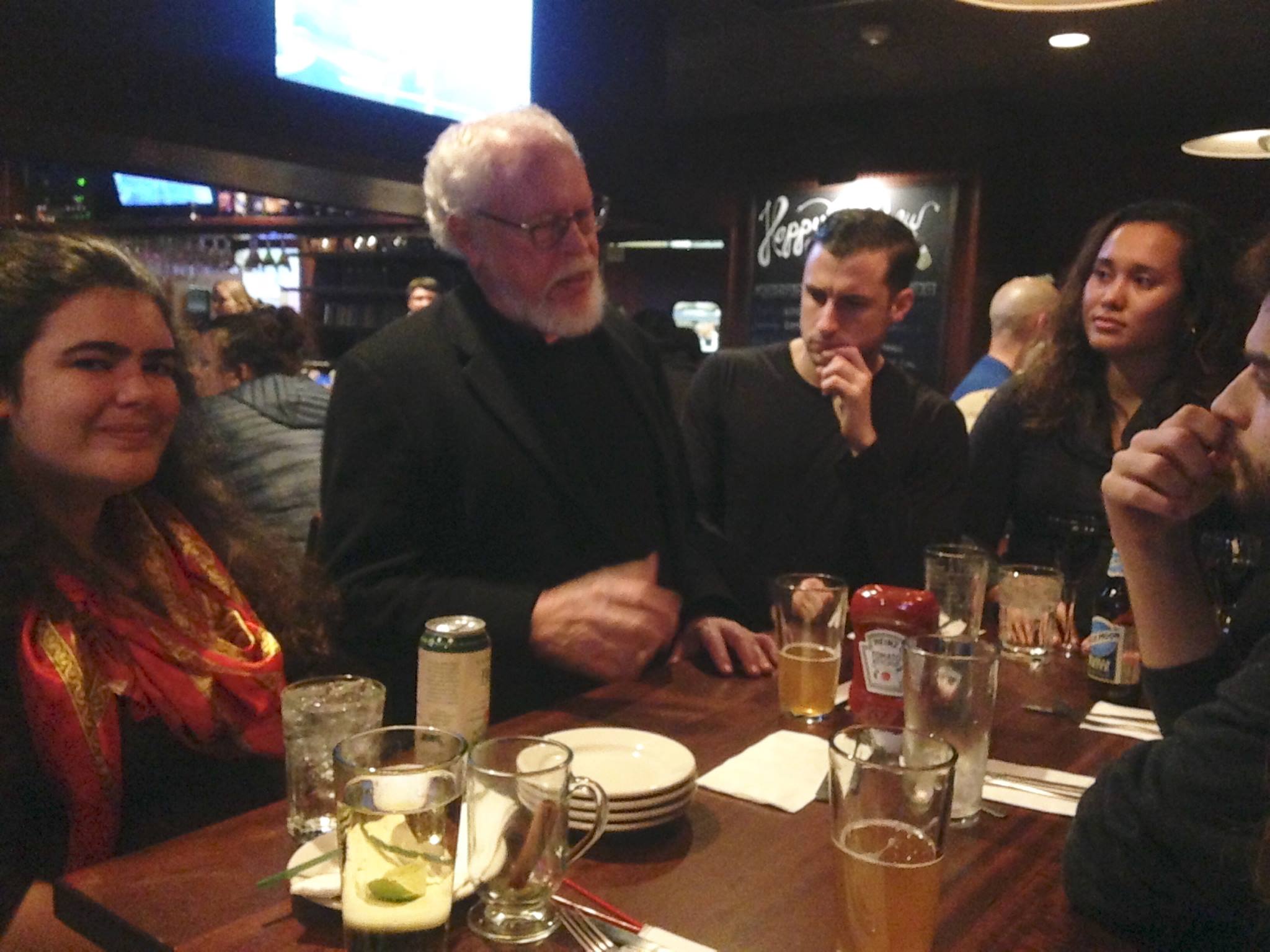
President Durwood Zaelke on NPR's Diane Rehm Show with Elizabeth Rosenthal of The New York Times

Steve Yurek, Diane Rehm, Durwood Zalke (photo: AHRInet.org)

The Hill, Op-Ed by D. Zaelke & A. Light, “Rio meeting can still produce a key climate outcome” (20 June
2012)

The Hill, Op-Ed by M. Molina & D. Zaelke, "How to cut climate change in half" (14 February 2012)

President Durwood Zaelke on NPR's All Things Considered

An Indian street dweller prepares food on the streets of Kolkata. A growing number of scientists say that reducing black carbon — mostly soot from burning wood, charcoal and dung — would have an immediate and powerful impact on climate.

UNEP's "Our Planet: Powering Climate Solutions" with articles by Mario Molina, A.R. Ravishankara, and Durwood Zaelke; Romina Picolotti; and Veerabhadran
Ramanathan and Nithya
Ramanathan
(Dec 2011)

Proceedings of the National Academy of Sciences: "Reducing abrupt climate chante risk using the Montreal Protocol and other regulatory actions to complement cuts in CO2 emissions" (12 October 2009)

IGSD Fast-Action Films:

UNEP Executive Director Achim Steiner highlights non-CO2 SLCPs:

Black carbon expert V. Ramanathan emphasizes importance of targeting non-CO2 SLCPs:

Nobel Laureate Mario Molina talks about need for action on fast half of climate change:

IGSD President Durwood Zaelke's testimony before the European Parliament

IGSD Documents

  • The Need for Speed: Reducing Short-Lived Climate Forcers & Perfecting Deliberate Carbon Removal Strategies to Complement CO2 Reductions (English, Chinese, French)
  • Why phase down HFCs under the Montreal Protocol? (Nov 2011)
  • Questions & Answers About Regulating Hydrofluorocarbons Under the Montreal Protocol (Nov 2011)

Top 10 Reasons for Addressing Non-CO2 Climate Forcers (Chinese version here)

Calendar

Recent Publications

IGSD: "Primer on Short-Lived Climate Pollutants" (2013)

Spanish version of the Primer is here.

The Primer is also available on the CCAC website here.


UNEP Report: "The Montreal Protocol and The Green Economy" (2012)


UNEP and WMO's full 250 page "Integrated Assessment of Black Carbon and Tropospheric Ozone" (2011)


Science: "Preserving Montreal Protocol Climate Benefits by Limiting HFCs" by Guus J. M. Velders, et al. (24 February 2012)


Science: "Simultaneously Mitigating Near-Term Climate Change and Improving Human Health and Food Security" by Drew Shindell, et al. (13 January 2012)


UNEP Synthesis Report: "Near-term Climate Protection and Clean Air Benefits: Actions for Controlling Short-Lived Climate Forcers" (25 Nov 2011)


UNEP Synthesis Report: "HFCs: A Critical Link in Protecting Climate and the Ozone Layer" (November 2011)


UNEP and WMO's "Integrated Assessment of Black Carbon and Tropospheric Ozone: Summary for Decision Makers" (June 2011)


"Fate of Mountain Glaciers in the Anthropocene", a report by the working group commissioned by the Vatican (11 May 2011)


News

UNEP OzonAction's December 2011 Special Issue "Tipping the Balance" with an article by Steve Andersen and Kristen Taddonio


View archived news

View additional SLCP Press Coverage

Arctic Council Calls for HFC Phase Down under Montreal Protocol

Arctic Council Ministers from Canada, Denmark, Finland, Norway, Sweden, Russia, and the U.S. yesterday called for taking action “as soon as possible” to phase down HFCs under the Montreal Protocol, as well as taking other actions to reduce black carbon and methane emissions in the Arctic. Noting that such actions “could slow global and Arctic climate change and have positive effects on health,” the ministers, including U.S. Secretary of State John Kerry, echoed the growing international support for fast action to reduce these climate pollutants to slow the accelerating rate of climate change and protect the planet’s most vulnerable regions and peoples.

“The Arctic Council’s Kiruna Declaration is major step forward and just in time,” said Durwood Zaelke, President of the Institute for Governance & Sustainable Development.  “Protecting regions like the Arctic and Himalayas that are warming at more than twice the global average requires immediate, targeted action against the climate pollutants causing massive harm right now.  Saving these regions and the peoples who live there cannot wait,” Zaelke added.  “It will be too late to save the Arctic once it’s melted.” As highlighted by the Arctic Council, reducing black carbon, methane, and HFCs is a critical opportunity to cut the rate of global warming in half and to cut the rate of warming in the Arctic by two thirds over the next few decades.  

Secretary Kerry reminded the ministers that carbon dioxide emissions had breached the 400 parts per million guard rail last week, stating “So the scientific research in each of our countries is more imperative than ever in order to protect the atmosphere, the global economy, the food chain and the air we breathe. And we need to do more — all of us — urgently.”Read more from IGSD’s Press Release here.

Super Pollutant Reduction Act Introduced in Congress

Washington, D.C., 9 May 2013 — Congressman Scott Peters (D-Calif.) introduced the Super Pollutant Emissions Reduction Act of 2013, or SUPER Act, H.R. 1943, to establish a U.S task force to reduce super climate pollutants under existing authorities.  The super pollutants, also known as short-lived climate pollutants because they remain in the atmosphere for only short periods, include black carbon, tropospheric ozone, methane, and hydrofluorocarbons (HFCs). The bill designates these as “super pollutants” because they are hundreds to thousands of times more potent in their warming effects than carbon dioxide.  Collectively, these “super climate pollutants” have contributed up to 40% of observed global warming to date. 

Because they are often thousands of times more powerful than carbon dioxide, reducing these pollutants is essential for slowing the rate of climate change in the near term and reducing dangerous climate impacts over the next several decades.  “Given the major impact of these super pollutants on our environment it only makes sense to use already existing technologies to reduce our emissions and slow climate change,” said Congressman Peters.

“This bill comes at a perfect time,” said Professor V. Ramanathan at Scripps Institution of Oceanography, University of California, San Diego.  “Science has informed us that it is still not too late to slow down warming in the coming decades by a factor of two if we act now" to reduce these super pollutants.

“Taking decisive domestic actions will deliver concrete benefits here at home, and help restore U.S. leadership on climate protection worldwide,” said Durwood Zaelke, President of the Institute for Governance & Sustainable Development. Read more from IGSD’s Press Release here.

China, Montreal Protocol Team Up to Eliminate Equivalent of 8 Billion Tonnes of CO2

We probably should start putting a date here]The Multilateral Fund of the Montreal Protocol will provide China $385 million over the next 17 years to completely eliminate its industrial production of hydrochlorofluorocarbons (HCFCs) by 2030, which will avoid the equivalent of 8 billion tonnes of CO2. HCFCs are factory-made gases used in refrigeration, air conditioning, and insulating foams that both warm the climate and destroy the stratospheric ozone layer, causing skin cancer, cataracts, and other harms, including suppression of the human immune system. Under the terms of the treaty, the funding mechanism of the Montreal Protocol, the Multilateral Fund, is required to pay the “agreed incremental costs” for developing countries making the transition from harmful HCFCs to more environmentally friendly substitutes.

“The Montreal Protocol is once again demonstrating how important it is for climate protection by striking a deal with China this week to cut the equivalent of 8 billion tonnes of carbon dioxide emissions—for the bargain basement price of less than five cents a tonne,” said Durwood Zaelke, President of the Institute for Governance & Sustainable Development.“China’s willingness to accelerate its phase out of HCFCs is a positive sign those who care about climate change hope will be matched by China’s willingness to avoid moving into the super greenhouse gas HFCs as replacements. Otherwise, a move into HFCs would cancel the climate benefit many times over, and be a major setback for the Montreal Protocol.”

Earlier this month, Micronesia and Morocco filed a proposal to phase down HFCs under the Montreal Protocol, as did the North American countries. Read more from IGSD’s Press Release here.

Micronesia, Morocco Seek Fast HFC Reductions to Slow Sea-Level Rise, Other Climate Impacts

Washington, DC 16 April 2013 - The Federated States of Micronesia and the Kingdom of Morocco on April 16 formally filed a proposal to use the Montreal Protocol treaty to phase down the use of hydrofluorocarbons (HFCs), super-greenhouse gases that have global warming potentials hundreds to thousands of times higher than carbon dioxide. The proposal came two days after research led by Dr. V. Ramanathan of the Scripps Institution of Oceanography concluded that the rate of global warming could be cut in half by 2050, and sea level rise could be reduced by a quarter by the end of the century, through reductions of HFCs and other short lived-climate pollutants, including methane, tropospheric ozone, and black carbon. The North American parties, including the United States, Canada and Mexico, filed a similar proposal. “Reducing HFCs is critical for slowing both temperature increase and sea-level rise,” said Micronesian Ambassador Asterio Takesy. “We are happy the U.S. shares our view on using the Montreal Protocol to reduce HFCs. As a native of the Pacific islands himself, we hope that President Obama will help us to seal an agreement on HFCs this year.”

Micronesia has a history of success at bringing about effective climate mitigation under the Montreal Protocol. In 2007, the Montreal Protocol Parties agreed to a historic proposal led by Micronesia to accelerate the phase-out of HCFCs. Since then, support for phasing down HFCs under the Montreal Protocol has been steadily increasing, with more than 100 countries showing support. “Micronesia and Morocco are throwing a lifeline to other island and coastal countries,” said Durwood Zaelke, President of the Institute of Governance and Sustainable Development (IGSD). Read more from the Micronesian Proposal and FSM’s Press Release.

Reducing Air Pollution, Chemical Coolants Can Quickly Cut Sea-Level Rise

Washington, DC 14 April 2013 – Sea-level rise—a growing threat that washes away beaches, attacks costal development, and raises the platform for launching ever more damaging and deadly storm surges—can be cut significantly by reducing local air pollution from black carbon, methane, and tropospheric ozone, along with factory-made coolants called HFCs. This is the conclusion of a multi-year research effort led by Professor V. Ramanathan at Scripps Institution of Oceanography, University of California, San Diego, published online 14 April by Nature Climate ChangeThe study calculated that the annual rate of sea-level rise could be reduced up to 24% by 2100 by controlling these four climate pollutants, and that cumulative sea-level rise could be reduced by 22%.

 “This ground-breaking study provides the blueprint for climate justice this century,” stated Durwood Zaelke, President of the Institute for Governance & Sustainable Development. “Cutting these air pollutants and chemical coolants can cut warming in half for many decades, and is essential for protecting vulnerable people and places this century,” he added. “Failure to cut SLCPs will halt the impressive gains in poverty reduction of the past few decades,” Zaelke said, “and drive millions more into extreme poverty.” Because three SLCPs are potent air pollutants, cutting them can save millions of lives every year, while significantly increasing crop yields, making this important for promoting sustainable development. In South Asia, for example, air pollution is the leading preventable cause of disease, according to a recent report by the World Health Organization. Read more from IGSD’s Press Release here.

Climate Impacts Could Reverse Decades of Progress Reducing Poverty

Gains in poverty reduction made in the past two decades could be halted or reversed by climate change impacts, according to the United Nations Development Programme 2013 Human Development Report, The Rise of the South: Human Progress in a Diverse World. The report, released March 14, calculates that the share of the world's people living in extreme poverty was cut nearly in half, to 22% in 2008from 43% in 1990. Gains were made in 40 developing countries, including 500 million people in China.

But “environmental inaction,” especially related to climate change could “halt, or even reverse” progress. The report finds that climate change is “already exacerbating chronic environmental threats,” and concludes, “The number of people in extreme poverty could increase to three billion by 2050 unless environmental disasters are averted by coordinated global action.” IGSD's Durwood Zaelke noted, “The best way to protect the significant gains in poverty reduction and human development threatened by climate impacts is to reduce black carbon soot, tropospheric ozone, methane, and factory-made HFCs. This fast-action strategy can cut the rate of global warming in half for the next several decades and protect the gains in poverty reduction that otherwise will be wiped out by accelerating climate impacts.” Read more from The Human Development Report.

U.S. NGOs Call for Task Force to Combat Short-Lived Climate Pollutant

U.S. NGOs are urging the Obama Administration to establish an inter-agency task force to reduce short-lived climate pollutants (SLCPs), including black carbon, methane, and HFCs, as a key strategy to reduce near-term climate change impacts. On March 12, the Center for Climate and Energy Solutions (C2ES) released a policy brief outlining steps the federal government can take to reduce SLCPs through existing authorities and executive actions. This follows an earlier letter to the Administration from a coalition of U.S. NGOs organized by Ambassador Nancy Soderberg for the Connect U.S. Fund, including 181 foreign policy experts, calling for an SLCP Task Force.

"As the nation's largest fleet operator, landowner, purchaser, and property manager, the federal government has the ability and the responsibility to lead by example in limiting its emissions of short-lived climate pollutants,'' stated Stephen Seidel, senior advisor at C2ES. “Fast action mitigation to reduce SLCPs was an important part of Senator Kerry’s climate strategy, and as Secretary of State he's already on record supporting SLCP strategies,” said Durwood Zaelke, President of IGSD. “It’s now more urgent than ever that the U.S. pursue SLCP mitigation, as this is the only way to reduce near-term impacts.” Read more from C2ES Brief, Connect U.S. Letter.

Air Pollution, Among Top Global Killers, Is Critical Climate Target

Washington, DC 8 March 2013 – Indoor air pollution is the fourth leading global risk factor for death according to the Global Burden of Disease study produced by 488 researchers from 50 countries. This puts air pollution behind poor diet and high blood pressure, and about the same as tobacco smoke as a preventable risk for early mortality, globally.

“Reducing air pollution, which includes black carbon soot pollution, can save millions of lives a year, reduce crop losses significantly, and cut the rate of global warming in half and the rate of warming in the Arctic by two-thirds over the next few decades,” said Durwood Zaelke, President of the Institute for Governance & Sustainable Development. “With this combination of benefits—healthier citizens, higher crop yields, and half the rate of climate change—reducing air pollutants should be a top priority for sustainable development.”

The study was published online this week by the Institute for Health Metrics and Evaluation at the University of Washington with interactive graphics that allow policymakers and public health officials to compare “modifiable” causes of death and disability among countries, and over time. The effort was funded by the Melinda & Bill Gates Foundation. Read more from IGSD’s press release.

Landmark Climate and Clean Air Coalition to Reduce Short-Lived Climate Pollutants Celebrates First Anniversary

Nairobi, Kenya 19 February 2013 – The Climate and Clean Air Coalition to Reduce Short-Lived Climate Pollutants (CCAC) celebrates its first anniversary tomorrow.  Launched by Secretary of State Hillary Clinton with an initial group of six country partners and the United Nations Environment Programme, the Coalition has quickly grown to 55 partners, including 27 countries, the European Commission, as well as the World Bank, the United Nations Development Programme, the United Nations Industrial Development Organization, and eighteen NGOs. Read more from IGSD’s press release.

Expert Engineers Re-confirm Climate-Friendly Refrigerant, Rejecting Daimler's Claims as "Highly Improbably"

Washington, DC 13 February 2013 - SAE International (formerly known as the Society of Automotive Engineers) has reconfirmed that R-1234yf is a safe and acceptable alternative to the super-greenhouse gas HFC-134a now used as a refrigerant in automobile air conditioners. R1234yf has a global warming potential (GWP) of just 4 compared to the 1,430 GWP of HFC-134a. HFC-1234yf has been approved as a refrigerant in motor vehicle AC by the United States Environmental Protection Agency (EPA), the Japan Ministry of Economy, Trade, and Industry (METI), and the European Commission (EC). Mobile air conditioning is the largest emission source for HFC-134a. In addition ,mobile air conditioners use from 3 percent up to 20 percent of a vehicle's fuel, depending on the regional climate, adding additional climate pollution from CO2. Read more from IGSD’s press release and NRDC’s blog.

Reducing Black Carbon, HFCs, Methane Key to Protecting Arctic in Near-Term, Say Arctic Ministers

Washington, DC 6 February 2013 - The US can use existing authority to help meet its pledge to reduce emissions by 17% below 2005 levels by 2020, although Congressional action will be needed to meet the steeper emission cuts needed to avoid the worst impacts of climate change. This is the conclusion of a report issued today by the World Resources Institute, Can the U.S. Get There From Here? Using Existing Federal Laws and State Action to Reduce Greenhouse Gas Emissions.The WRI report concludes that “Eliminating HFCs [hydrofluorocarbons] represents the biggest opportunity for GHG emissions reductions behind power plants” and recommends that the U.S. Administration reduce HFCs using both the Montreal Protocol and the Clean Air Act. Read more from IGSD's press release.

Comprehensive Four-Year Study Finds Black Carbon Second Biggest Climate Pollutant Behind Carbon Dioxide

Going Beyond Carbon Dioxide: New York Times Op-Ed by Zaelke & Ramanathan

Growing Enthusiasm for Reducing Short-Lived Climate Pollutant for Fast Climate Mitigation

Permafrost Thawing to Cause Additional Global Warming

Alarming Growth of Climate Emissions Says UNEP, But No Reason to Write Off 2°C Target Yet

A 4°C World Will Be Devastating But Can Be Avoided

South Africa, other climate vulneralbe countries support fast action to reduce HFCs under Montreal Protocol

Global Leaders Call for Action on Super Greenhouse Gases as Ozone Treaty Celebrates 25th Anniversary

A Climate Success Story to Build On

Climate Change Could Kill More Than 100 Million People by 2030

Arctic Loses a Quarter-Million Square Miles of Sea Ice After Record Low Announced in August

World's Most Successful Environmental Treaty Turns 25

Additional IGSD Press Releases